guide
What Is Personal Color Analysis? Method, Limits, and a Practical Test
Learn what personal color analysis observes, how the seasonal framework works, and how to test color temperature, value, chroma, and contrast.
Personal color analysis is a styling framework for comparing colors near the face. It asks a practical question: which versions of color create the most useful visual relationship with your skin, hair, and eyes under comparable conditions?
It does not measure health, attractiveness, ethnicity, or a permanent biological type. A season name is a compact description of observed color relationships—not a diagnosis.
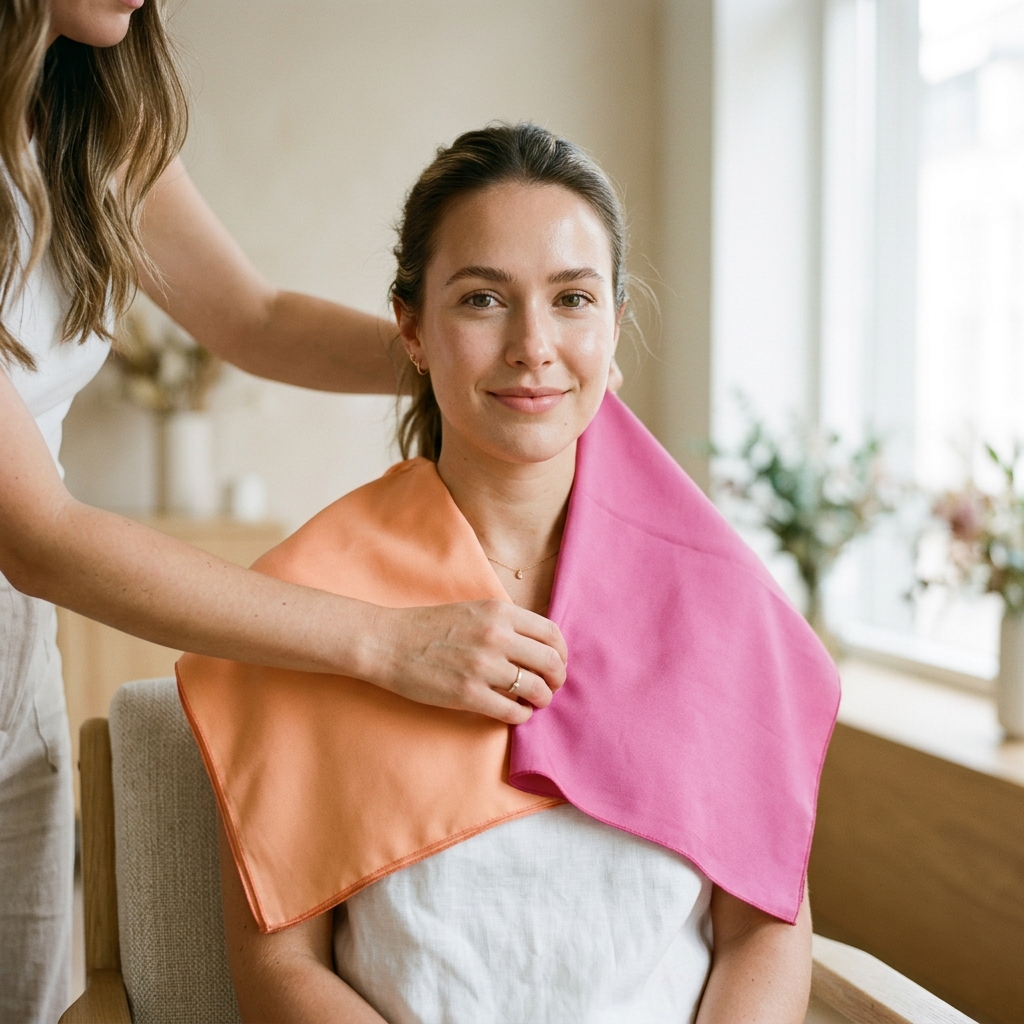
Quick answer
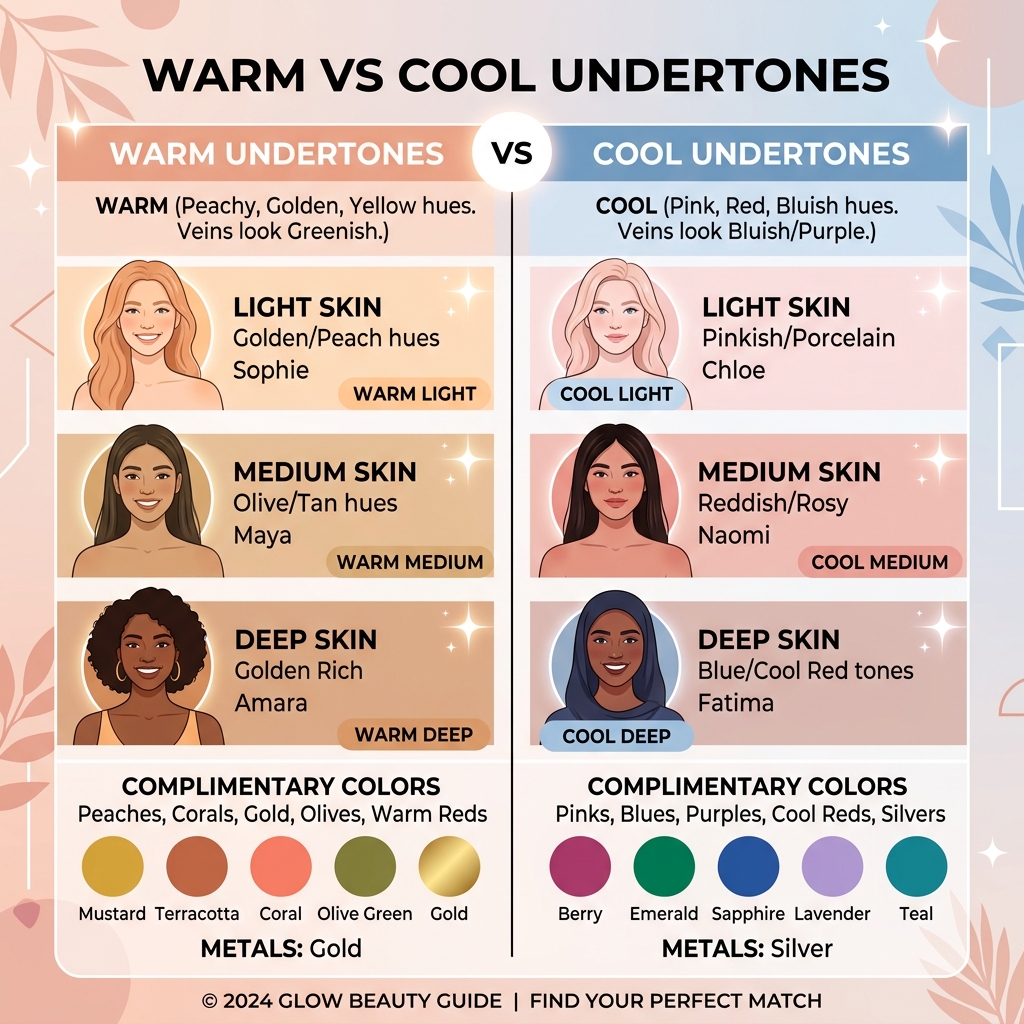
Most seasonal systems sort observations along four axes:
- Temperature: warmer/yellower versus cooler/bluer color direction.
- Value: lighter versus deeper colors.
- Chroma: clearer/more saturated versus softer/more muted colors.
- Contrast: how much light-dark or color contrast the overall styling can carry before the clothes dominate the face.
The four parent seasons are shorthand combinations: Spring is generally warm and clearer, Summer cool and softer, Autumn warm and softer/deeper, and Winter cool and clearer/deeper. A twelve-season system refines each parent season into three neighboring directions. The boundaries are conventions, so the useful output is the attribute pattern behind a label.
Measurement and interpretation are not the same thing
| Layer | Details |
|---|---|
| Source color | What can be observed or measured: Pixel values, fabric color, lighting conditions; What still requires interpretation: Whether the captured color represents real-life appearance |
| Face context | What can be observed or measured: Relative skin, hair, and eye colors in that setting; What still requires interpretation: Which visible changes count as more harmonious |
| Comparison | What can be observed or measured: Difference between two controlled drapes or images; What still requires interpretation: Whether the difference matters enough for a purchase |
| Seasonal label | What can be observed or measured: A rule-based combination of temperature, value, and chroma; What still requires interpretation: Where to draw the boundary between neighboring seasons |
This distinction matters. A camera can record values, and a person can compare drapes, but neither automatically proves that “Soft Summer” is the only correct label.
The EverlySpark framework
EverlySpark uses one consistent vocabulary across its guides:
| Axis | Details |
|---|---|
| Temperature | One end: Warm; Other end: Cool; Practical question: Does a warmer or cooler version of the same color sit more cleanly beside the face? |
| Value | One end: Light; Other end: Deep; Practical question: Does the face stay present beside pale colors, dark colors, or both? |
| Chroma | One end: Soft; Other end: Clear; Practical question: Do grayed colors look refined, or drained? Do vivid colors look lively, or loud? |
| Contrast | One end: Low; Other end: High; Practical question: Does a quiet combination support the features, or does stronger separation make them clearer? |
Contrast is related to value and chroma, but it is not a substitute for either. A person can have dark hair and light skin yet prefer moderately muted colors; another can have lower visible feature contrast yet carry a crisp accent. That is why a one-clue shortcut—veins, jewelry, hair color, or eye color—cannot settle the whole analysis.
How an in-person draping comparison works
A useful draping session changes one variable at a time:
- Use stable, neutral lighting.
- Remove strongly colored makeup and move dyed hair away from the face when possible.
- Hold similarly sized fabrics in the same position.
- Compare pairs designed to isolate one axis: warm red versus cool red, clear blue versus muted blue, light neutral versus deep neutral.
- Look for repeatable differences across several pairs, not one dramatic swatch.
- Record the winning attribute pattern before assigning a season name.
A consultant adds trained observation and can swap drapes in real time. The tradeoff is that analyst training and taxonomy are not standardized across the entire industry. A second analyst may use different labels, particularly near a boundary.
A controlled comparison you can run at home
Use two versions of one hue rather than unrelated colors. For example:
- peach versus blue-pink for temperature;
- powder blue versus navy for value;
- clear turquoise versus gray-teal for chroma.
Stand in indirect daylight, lock the camera exposure if you photograph the test, keep distance and angle fixed, and cover bright clothing with a neutral towel. Alternate the pair several times.
Watch the face, not the fabric. Useful questions are:
- Does one option make uneven redness or shadows more noticeable?
- Does one color appear first while the face recedes?
- Do the eyes, brows, and mouth remain legible without added makeup?
- Is the effect consistent across a second color pair testing the same axis?
These are observations, not medical or physiological findings. If the effect disappears when the lighting changes, confidence should fall.
How EverlySpark’s photo-based tool differs
EverlySpark’s browser-based analyzer samples visible colors from a supplied photo and applies fixed rules. It is not a professional draping session and is not presented as a clinically validated diagnostic or a measured accuracy claim.
A photo introduces extra variables: white balance, exposure, camera processing, compression, colored walls, makeup, hair dye, and where the sampling points land. The result is best treated as a hypothesis to test with real garments or drapes.
| Method | Details |
|---|---|
| In-person draping | Useful for: Repeated real-time comparisons; Main limitation: Analyst judgment and system labels vary |
| DIY draping | Useful for: Low-cost attribute testing; Main limitation: Harder to control lighting and self-bias |
| Photo-based rules | Useful for: Fast, repeatable first estimate from one image; Main limitation: Camera and sampling conditions can distort inputs |
From four seasons to twelve
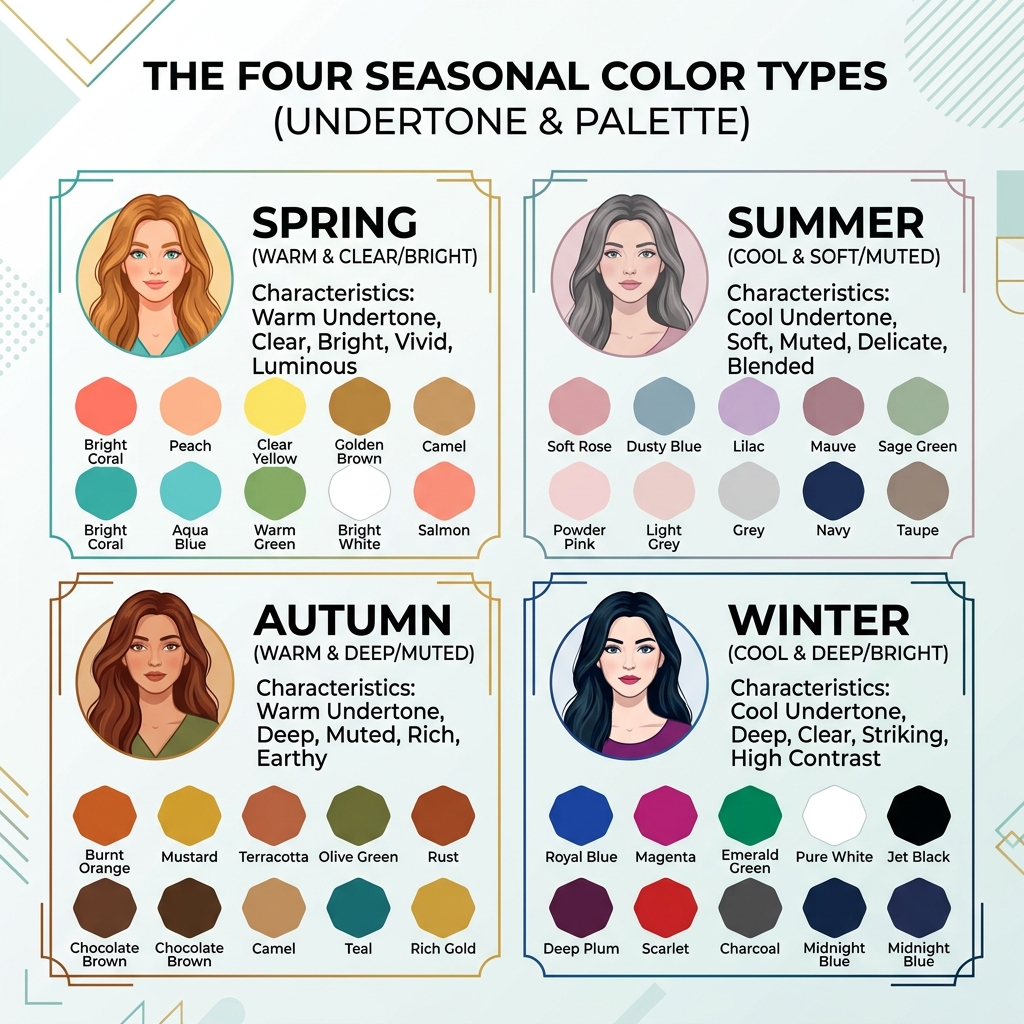
The four-season level is a broad orientation. EverlySpark’s twelve-season vocabulary adds a dominant direction within each family:
- Spring: Light Spring, True Spring, Bright Spring
- Summer: Light Summer, True/Cool Summer, Soft Summer
- Autumn: Soft Autumn, True Autumn, Deep Autumn
- Winter: Deep Winter, True/Cool Winter, Bright Winter
Read “Light,” “Soft,” “Deep,” and “Bright” as attribute priorities. For example, Light Spring is not simply “a warmer Spring”; light value is its strongest constraint. Soft Autumn is not every warm person who dislikes bright color; muted chroma is the defining direction.
Some consultants and online systems use different names. “Warm Spring” may replace “True Spring,” and nonstandard labels such as “Soft Spring” may appear. When labels conflict, compare the underlying axes. Our Light Spring versus Soft Spring guide shows how to do that without pretending the naming systems are identical.
What a season result can—and cannot—do
A useful result can:
- narrow the versions of a color worth trying first;
- explain why two reds or two navies behave differently;
- guide near-face clothing, frames, jewelry, and makeup;
- reduce repeat buying mistakes.
It cannot:
- certify a person’s health or beauty;
- override fit, texture, comfort, culture, or preference;
- guarantee that every color in a printed or digital palette will match its intended appearance;
- prove that twelve categories are the only valid way to organize color;
- turn one photo into certainty.
For the evidence boundary behind those statements, read Is Seasonal Color Analysis Backed by Real Science?.
A decision path for beginners
Start with the broadest stable signal.
- If warm/cool comparisons repeat clearly, test value next.
- If temperature is mixed but light versus deep is obvious, let value lead.
- If both are close, test clear versus muted.
- If every pair changes with lighting or makeup, stop assigning a label and improve the test conditions.
Then compare your pattern with the full 12-season guide. Use the season as a shortlist. Validate actual purchases with the specific fabric, finish, and lighting in which you will wear them.
Method and limits
Temperature, value, chroma, and contrast give you a practical vocabulary for narrowing clothing and makeup colors. The framework above is EverlySpark’s editorial synthesis of common seasonal-color practice, color-appearance principles, and the disclosed logic of its tool. These are styling observations, not a validated diagnostic method or a measure of health, attractiveness, or a permanent biological type. Different seasonal systems can draw their boundaries differently.
Repeating a comparison helps you see whether a preference persists across colors and conditions. No fixed number of repetitions guarantees accuracy, and a consistent result does not by itself establish that one seasonal label is uniquely correct. If the result changes with lighting or camera settings, improve the setup before making a purchase.
Editorial illustrations explain styling ideas. They are not calibrated color swatches, real before-and-after results, or evidence of a test EverlySpark performed. Use the actual garment or product to check color and finish.
Sources and further reading
- Michel Eugène Chevreul, The Laws of Contrast of Colour (English edition in the Project Gutenberg archive). Historical primary source for simultaneous-contrast concepts; not a seasonal-personal-color study.
- David I. Perrett and Richard Sprengelmeyer, “Clothing Aesthetics: Consistent Colour Choices to Match Fair and Tanned Skin Tones,” i-Perception 12(6), 2021. Peer-reviewed clothing/skin-color preference experiments; not validation of twelve seasons.
- EverlySpark seasonal-color evidence review, including the limits of the taxonomy.
Source check: September 7, 2026. Links and claims should be rechecked if a source page changes.
FAQ
Is personal color analysis scientifically proven?
Nearby colors can affect color appearance, and limited research has found systematic clothing-color preferences relative to photographed skin appearance. That does not validate one universal four- or twelve-season classification. The mechanism and the consumer taxonomy have different evidence strength.
Is undertone the most important axis?
Not for everyone. Temperature is influential, but value or chroma can be the clearer constraint. EverlySpark records all four axes before treating a seasonal label as useful.
Can a season change?
A captured result can change when tanning, hair color, makeup, lighting, or camera processing changes. That does not prove an underlying trait changed; it shows that the visible comparison context changed. Retest when appearance or conditions materially change.
Should I use the analyzer or a consultant?
Use the method that fits the decision. The method comparison above explains the tradeoffs between the analyzer, DIY draping, and an in-person consultation.